Heading to Havana


We were getting anxious to see the big city, so after about a month of Cay hoping on the south coast, we decided to set our sights on Havana.  We still had about 350 miles ahead of us, so we wanted to get moving.  We opted not to go ashore on the Isla de la Juventud, although we have heard it is pretty.  We sailed along the south coast of the island and anchored for the night in Caleta Puerto Frances.  It is a very pretty spot with crystal clear water and tons of sand dollars on the bottom.  We timed our departure so that we would round Cabo de San Antonio (the southwestern Cape) during the very early morning hours (i.e. 3 – 4am) because we had read that it can get quite nasty rounding the cape and the best time to do it is late evening to early morning when the winds are at their lightest.  We indeed had light winds and an uneventful passage. 
On the way north to Havana, there is a reef that runs for about 120 miles along coast line with some breaks where boats can get through.  Nigel Calder writes that if your draft is 1.8m or less, you can run the entire way inside the reef.  We draw just under 7 feet, and keeping an eye on the tides, we did the majority of the run inside the reef with a few passages outside. 

After rounding the Cape, we headed inside and tried to anchor by Los Arroyos.  According to Nigel Calder’s book, it is a pretty little fishing village with a nice main street to walk up and down.  We never got to see it.  Two Aduana (Customs officials) rowed out to see us in a sinking skiff and asked to come aboard.  They didn’t speak any English but were very friendly.  They asked to see our papers and started the clearing in process.  While one of the officers was completing this process, the other borrowed our VHF to call his boss on shore.  I heard some arguing going on and based on my limited Spanish, knew we had a little problem.  Evidently, we were not allowed to go ashore.  The officer had no idea why, and that was what he was arguing with his boss about.  “No problemo”, I said.  “Was it okay to just anchor for the night and sleep and leave in the morning?”  “Of course”, they said.  Just then, Sabbaticus, our friends, sailed next to us and dropped anchor.  We told the officers who they were and we were sailing together.  The official went back to the VHF and called his boss again.  After much conversation, we were told very nicely, that actually, we were not allowed to anchor there because there was much military around.  We would have to motor to an uninhabited Cay about 2 miles away and anchor there.  And then they say something in Spanish and pointed to their eyes.  I nodded and thought to myself, of course you can watch us leave.   The sun was going down as we motored over to Punta Mosquito and dropped the hook, giving the island a wide berth just in case it lived up to its name.  We cooked some dinner and it was pretty dark outside, so Maria decided to take a quick shower on deck.  We went to sleep and got up around 7 am the next morning to get going.  Don’t you know that pretty close to us, in their sinking dingy, were the two officers from yesterday, drinking coffee and eating breakfast!  They had rowed over some time the night before, slept in their skiff and watched our boat to make sure we didn’t get off of it and leave when we said we would!  As always, they were very friendly and gave us huge smiles and waves as we hauled anchor and continued on our way!  I hope they enjoyed Maria’s shower!!

Our next run took us about 25 miles inside the reef until we got to Cayo Jutias and we had to pop out through the reef for 6 miles to get around the Cayo as there is no passage inside.  We exited at Quebrado de la Galera with no problems.  It wasn’t too bad outside, maybe 6 -7 foot swells, about 8 seconds apart.  We knew the weather was forecasted to pick up, but so far, it was very comfortable.  We motor sailed around the Cay and Sabbaticus called us up on the VHF and said it was only about 18 hours to Havana and did we want to just go for it on the outside.  Like I said, at this point is was fairly comfortable – the waves were on our forward quarter so we were bucking a little bit, but not that bad.  As we got into late afternoon, the winds picked up and so did the sea state and the wave period shortened.  We knew we were running low of fuel but had enough to get to Havana.  We weren’t making great time beating into the seas and was considering going inside to find and anchorage and try again in a little better weather the next day, so we started looking for a break in the reef to go through in case we decided to do this.  We were on a port tack which had us heading toward land when the engine quit.  Great.  Since we were motor sailing, we only had the main up, so we hurried to get some more sail area up.  The wind was at the wrong angle and the seas had built up and we were getting pushed towards the reef.  We were about half a mile away from the reef and we tried to tack (go through the wind), but we did not have enough power under sail alone to get our nose through the seas.  Bugger.  We were now about a quarter mile from the reef and could hear and see the waves breaking.  We had to gybe.  We did a controlled gybe, but the wind was pretty strong and so it was not so controlled and I ended up with a nice rope burn from the main sheet, but we got her around and started sailing as best we could away from the reef.  With that under control, Maria went down to try and get the engine started.  It seems that we had a clogged fuel filter from the all the sludge in the bottom of the tank getting sloshed around and not much fuel.  She switched over to our second racor and then had to bleed the engine – not fun when you are getting tossed around a bit.  Finally the engine started and we let our friends on Sabbaticus know that we were okay and were heading in.  They had put their engine in idle and were waiting to see if we needed help, and they said they had drifted half a mile toward the reef in 20 minutes in those conditions!  Anyway, the break in the reef was pretty wide and we decided to sail in just in case the engine failed again as we were trying to get in.  The bottom went from about 600 feet to 50 feet to 15 feet in no time as we were sailing through the cut, the waves were heaping up to about 8 – 10 feet and breaking on our beam.  Sabbaticus actually called us up to make sure we weren’t on the reef because the waves were breaking so badly by us!  We sailed in with adrenaline flowing but no incident and made our way to the calmest spot we could find and dropped the hook.  We fiddled with the engine for a while and decided that we would go as far as we could inside the reef so the seas would be smaller and hopefully our fuel filters wouldn’t get clogged again!

Our track during our engine problems!
Our friends on Sabbaticus were good enough to go along with our plan.  They are a catamaran and so in some of the shallower spots where the chart showed only 6’6” of water at MLW, they would go ahead of us and using their depth sounder, would find a path we could make it through.  Around Cayo Arenas and Cayo Paraiso the water was the skinniest.  Sabbaticus sounded a 7’2” spot and we held our breath as we skimmed over it.  We were lucky our fuel and water tanks were almost empty! 


We had pulled down a weather fax and saw that it was supposed to be pretty crappy for the next two days, so we decided to anchor by Cayo Paraiso and wait for the weather to pass before we carried onto Havana, as the next passages were all outside the reef.  Our mojitos would have to wait a few more days.  Cayo Paraiso was a nice place to be stuck, with a great beach for Niko to run on and a good reef to snorkel on.  After the weather broke, we exited the reef at Querbadode la Mulata at 2am – it is a wide open channel through the reef and we had no problems doing it in the dark.  We had a nice motor sail up to Havana and made it there later that afternoon.

Archipielago de los Canerreros, Cuba


Dinner!

The next week or so was spent sailing around the Archipielago de los Canerreros.   The cruising here is second to none, with pristine reefs, picture perfect islands and water of incredible color.  We left Cayo Largo and sailed on the outside (rather than inside the reefs) to our first island stop, Cayo del Rosario.  Here, you have the choice of anchoring in the Canal Rosario or inside the reef on the southwest end of the Cay.  We chose the reef anchorage, as well had settled weather, thought it would be a bit cooler and we read there could be crocodiles in the Canal!  The reef entry is straightforward and we anchored in about 10 feet of water.  There was a light chop in the anchorage, but that doesn’t really bother our heavy girl.  The snorkeling here is good, lots of fish and lobsters and the beach was very inviting to go for a walk.  There were lots of iguanas and juntas that tempted Niko to chase them.  We stayed here for two nights before heading off to Cayo Campos. 

Cayos Campos
Cayo Campos was about a 30 mile sail from Cayo Rosario, and again, we chose the outside route due to our depth constraints.  We entered the reef on the western end of the island and anchored to the east of the opening in about 8 feet of water.  Be careful of partially submerged steel stakes that are used to house grouper when in season.  The stakes are pretty easy to see.  Again, we were anchored her in pretty settled weather, and only experienced some light chop in the anchorage as the reef breaks up most of the seas.  There is a more protected anchorage closer to the island but we could not get up in there because of our draft.  Nigel Calder’s book has a good sketch of the two anchorages. 

About half an hour after we anchored, two men from the island came out to greet us.  They spoke only Spanish but we understood that they were inviting us to the island.  They were also out of gas.  We didn’t have any to spare, but sent them up to our friends on Sabbaticals who gave them some.  We got in our dink and away we went to the island. 

Cayo Campos is a monkey sanctuary and there is a small house which is home to 3 men who stay on the island for three months and then go back home for three months while another shift comes on to take care of the sanctuary.  I could never remember their names, so we just called them the “Boys of Cayo Campos”!  They were so nice and funny!  As soon as we got there, they got out their bucket of dog food and we went outside as they threw the food on the ground and called out to the monkeys.  Before we knew it, there were about 10 monkeys looking at us with caution as they scooped up the food and shoved it in their mouth.  A little while later, mama monkeys with their babies hanging on to their chest came out for the feast.  One of the Boys was able to hand feed one of the monkeys, but it is clear they are still very wild.  We got a tour of their meager hut and made plans to come back in the morning for another feeding. 

The next day, we went in again to see our new found friends.  We hung out with them for about an hour in their hut, chatting away with them and their only neighbor who is a fisherman who also lives on the island during a three month rotation.  They invited us to stay for lunch and cooked us up a delicious rice and conch dish.  They waited for us to eat before they did, as they only had a limited number of plates!  I was continually amazed at the generosity of these people who give so much and yet have so little.  After lunch, we went back to our boat but not before making them promise to have dinner with us that evening.  Later that night, we had a great pasta dinner and lots of rum.  I think it is the first time they ever had a meat sauce on their pasta!  They were so grateful that they promised to take us to their favorite snorkeling spot the following day. 
Conch lunch

We trucked in again to the island the next day and the Boys made good on their promise to take us to a great snorkeling spot.  They pointed out all kinds of fish and collected Flamingo Tongues (small shells) for the Captains of the two boats.  They apologized they couldn’t find more, but the shells are fairly rare.  They escorted us back to our boat and we gave them some old rope, garlic and an old pair of fins in exchange for the promise of some fish the following morning before we had to head out.  The next morning, they came out, fish and all.  They then proceeded to clean the fish in their skiff, so we didn’t have to do any of the work!  We said our farewells and made our way to Cayo Matitas, about 5 miles away.  We were sad to leave our friends and this island paradise.

We were very used to reef entries after cruising the southern coast of Cuba and getting behind the  reef on Cayo Matitas was another straight forward entry.  We anchored in about 10 feet of clear blue water in front of another beautiful sandy beach.  We did our usual routine of snorkeling, hunting for fish and lobster and a walk on the beach.  Life is pretty good cruising the south coast of Cuba!

Another dinner!
The Boys of Cayos Campos


The view at anchor

Our fish being cleaned and delivered!


Cayo Largo, Cuba


 Our plan was to go from Cienfuegos to Cayo Guano del Este and then to Cayo Largo.  This route takes you through the prohibited zone that is around the Bay of Pigs.  We cut a pretty good edge of the zone and didn’t have any problems as we never saw anyone patrolling this area so far out. 

We got to Cayo Guano del Este in the afternoon and it was ROLLY POLLY, so we looked at the guide book and decided to continue on another 5 miles to Cayos de Dios, which turned out to be a really nice Cay and not nearly as rolly.  We only stayed the night and continued on our way the next morning, but later learned that the Cay had some of the best snorkeling in the area, and wished we had stayed there at least another day. 

We got to Cayo Largo around noon and was greeted with a Catamaran high and dry on a reef about 500 yards from the entrance.  Evidently, the cat had mistaken the green buoy they had put out to mark the reef with a green channel marker – a good reminder that in Cuba, sometimes they use markers to mark the reef themselves, and not necessarily the channel, so you have to navigate with your eyes and to read the water around these parts and not just rely on your GPS.  Having said that, and earlier stating the channels are usually well marked, we found the entrance to Cayo Largo very confusing.  Now, remember, we draw just under 7 feet, so boats with under 6 feet draft wouldn’t have the same problem that we did.  But basically, as you come into the entrance, you can either go straight, which has channel markers, or you can go to the starboard, which also has channel markers, and there is a sand bar in between the two.  We have a forward looking depth sounder, so we are pretty comfortable going into shallower water, as long as we go slow and there is enough room to maneuver out .  So, looking at Nigel  Calder’s guide, it looked as if we could go to either side, and it looked as if we should go to starboard, so  we started to do that, and we were reading 6 – 6.5 feet.  So, we backed out of there and took the straight path.  It was pretty narrow and led us down a channel with mud flats on our port side and a concrete pier ahead of us.  Then there was a 90 degree turn that we had to do that brought us in front of the marina.  It is a pretty small marina and really tucked back in there and looked buggy, so we made another 90 degree turn and kept coming around, essentially making a giant U shape and anchored on the southwest side of Punta Sirena in about 8 feet of water.   We dignied into the marina to clear in and they tried to tell me that I had to take my boat into the marina to clear in.  I told them that I was not comfortable bringing my boat in there as there was not much room to maneuver and we don’t have the best turning radius.  They insisted that I bring my boat in and I insisted that I would not do that and that I was happy to dingy them out to the anchorage to clear in.  Finally after talking to 3 people and a little more convincing, they got in the dingy and came out to the boat to clear us in. 

There was a beautiful white beach just off of our beam where we had anchored and Niko loved to go over to it and run free.   The water was a beautiful turquoise color and is deep right up to the beach.  The sand is the softest I have ever felt and so white and clean.  It is a great anchoring spot!

We dignied to the dock and bar, where they have the dolphin enclosures, to walk over to the beach.  The immense span of white sand gave our calf muscles a great workout as we made our way to one of the many palapas lining the beach that gives much needed relief from the sun.  The water was beautiful, the people watching entertaining and the pina coladas, brought to us by the bar waiters, refreshing.  It was a great day.  Once it got later in the afternoon and everyone cleared out, we went back to get Niko so she could romp on the beach as well.  On the way back to the boat, we stopped at the dolphin enclosure, which was closed but there was a roped off walkway that you could get over and get right up to the water.  We stood there with Niko and tapped the water and called to the dolphins.  Two swam over to us and Niko had the time of her life, nose to nose with her favorite animal.  She was whining and barking and making all kinds of noise, but the dolphins didn’t mind and just stared at her.  It was pretty cool.  After a little while, one of the workers there asked us to leave, but did so very politely!


The next day I had the unenviable task of trying to renew our visas.  Canadians’ get a 3 month visa, but Americans only get a one month visa.  You can only renew in points of entry, and the next point of entry for us was going to be Havana.  Our visas’ would have expired before then, so I had to get it done in Cayo Largo.  I was told that I had to go to the airport and see immigration there.  I walked the mile or so to the airport in the heat and asked to see the immigration officer.  I had to wait for about an hour before I asked again, and finally was brought into see him.  Again, he asked me for proof of health insurance, and I explained that I had an international policy, but he said they would not accept it because I was American and no one would insure me if I got hurt in Cuba.  I tried to argue that I was covered, but he told me I had to go back to the marina and talk to the head of Immigration there.  If he would accept my insurance policy, then he would have to call the airport Immigration and I would have to go back to see them.  So, I walked back to the marina in the heat and hunted down the head of Immigration there.  I explained my problem and he told me not to worry about it.  He took my passport and about-to-expire visa and said he would go to the airport and take care of everything and to come back that afternoon.  I was a little hesitant to leave my passport with him, but in the end I did.  That afternoon, I came back to his office and true to his word, he had my passport and a renewed visa!   I chatted with him a bit and he pulled out a picture of his boy and told me it was his birthday.  I caught his drift and gave him a few CUCs to buy his son a birthday present.  Next I had to go to Customs to renew my cruising permit.  All boats only get a one month cruising permit.  This time, everything went smoothly and I received a renewed cruising permit and luckily, the customs officer did not have any children!

Cienfuegos, Cuba


We had an easy downwind run from Casilda to Cienfuegos.  As soon as we sailed into the entrance of the harbor, we were greeted with a huge painted wall that read “Bienvendios a Cuba Socialista”.  Even with my bad Spanish, I knew that it said “Welcome to Socialist Cuba”!  The anchorage is quite a ways into the Bahia de Cienfuegos, but it is a well-marked channel.  We anchored outside of the marina and dignied in to clear in.  All of the offices are right there at the marina and was very easy to check in.  As always, the officials were very friendly and respectful.  We did have to pay to anchor outside the marina, but it was only about $5 a day.  The marina had a nice bar with cold beers and appetizers.  They also have a small convenience store which sells eggs, some canned veggies, juices and of course, rum!  We didn’t find their prices to be much more than the stores in town.

After clearing in and having our necessary cold beer at the bar, we decided to go hit the town.  We walked a little way toward town and came across a local watering hole.  Wanting a little local culture, we decided to stop for a beer.  This was a local joint, with local beer from a keg, and thus local prices – 6 local pesos per beer, plus 5 pesos for the cup, which equaled about $0.25 US for the beer.  To be honest, you get what you pay for, but nevertheless, we stayed for another before we moved on!  We continued to walk in the general direction of town and found ourselves on the Malecon, which is the wide sidewalk that runs along the seawall.  It seems as if the entire population of Cienfuegos was hanging out on the Malecon, so we decided we were in the right spot.  We did as the thousand or so other locals did – bought a bottle of rum, or two, and sat up on the wall and watched the young and old Cubans strut their stuff.  What entertainment!  The guys were mostly dressed all in white – tight white jeans, a loose fitting white shirt and a styling belt and pair of shoes to finish the outfit.  The girls were dressed to kill in the tightest, sexiest dresses or skirts they could find.  And everyone just paraded up and down the sidewalk, stopping to talk to friends and then continued to saunter along.  It was quite a site.  When we got hungry, we walked over to the local Rapido, (their version of McDonalds and KFC combined into one) and fed our bellies.  Then we decided to parade up and down the Malecon, but not as successfully as the locals.  We did met some really nice people though.  We got wind of a concert going on and went to find it.  It was basically pretty bad music set up in a parking lot with a ton of people milling about, so we decided to head back to the Malecon and then back to the boat as it was getting pretty late. 

The next morning, we took a horse taxi to the center of town to go exploring.  It was a Sunday so not much was open, but we sat in a pretty courtyard for a while and admired the government buildings.  We walked around a bit and then headed back to the marina.  The following day, we went back to the center of town to see what it was like on a weekday.  It was definitely much livelier.  We traded some of our goods (old clothes, tooth brushes and tooth paste) for some fresh veggies and fruit.  We got some of our much loved street pizza, and then took a bike taxi back to the marina for about $2. 


Yacht Club
Every time we walked to town, we would pass by a beautiful colonial style building that turned out to be the Cienfuegos Yacht Club.  On our last night we were walking by and all decided we needed to see in side of course we weren’t really dressed for what event they had planed . We to put on our best high class attitudes and face. And made our way up the red carpeted stairs to the entrance of the Yacht Club.  No one even questioned us and we went inside to have a beer.  It was beautiful inside with all old pictures of Cuba and old cups and other trophies from the winners of yacht racers.  They were having a concert at the club later that night, but we decided not to stay as we had to get moving early the next morning, and no one wanted to sail with a hangover!  So, we made the mature decision to boogie home and got an early start the next morning.  The officials are at the marina 24 hours, so we were able to clear out at 6am and be on our way by 7am for the 40 or so mile run to Cayo Guano del Este, which was just a jumping off point to Cayo Largo.

Malecon during the day


Casdila and Trinidad, Cuba


Four guys hanging out on a bench
We had a great sail from Cayo Zaza de Fuera to Casdila.  We chose to go on the outside and then cut inside via the Canal de Drenton.  Aside from the occasional shoal or coral head, the cruising here has been great.  Most of the time, we have enough wind to push our big girl (usually been 15 – 18 knots, at least in the morning before it dies around noon) and very little seas.  We have also noticed that the channels and shoals are very well marked.

Our guide book had said to go to the fishing village of Casdila to clear in, and to expect the full range of officials, who could be bureaucratic,  to come out to your boat.  Well, we did as we read, but it was wrong!  Instead, we had to anchor across the bay by the Marina Cayo Blanco and cleared in at the marina.  The Guarda office is right at the marina and it is only one very nice guy there.  He came out to our boat to do his paperwork, did a quick check and that was it.  We asked him if it was possible to clear out the night before we wanted to leave and he said no problem. 

Best pork sandwiches in Cuba
We trucked to shore and decided to go exploring.  There really isn’t that much in Casdila except for a huge, 1960’s style, gaudy purple and orange all inclusive resort.  We went in to scoop it out, tried to order a few drinks but got denied because we didn’t have the special bracelet and they don’t except cash.  Meanwhile, Josh and Connor tried to play ping pong but got booted, as they too didn’t have the wrist bling bling.  However, on the way out, a very enterprising manager told us that he could make us a deal for the night.  For $10 CUC per person, we could have dinner and all the drinks we wanted.  Josh and Connor used their tough negotiating skills to work him down to $5 CUC for just drinks, as we had already eaten dinner.  The manager said okay and ran off to hunt down the elusive bracelets.  Well, Josh and Connor decided they didn’t need to spend $5 CUC, so they bailed back to the boats.  Kevin had decided to stay home in the first place, so it turned out to be girl’s night out!  

Great band at lunch
We started with some mojitos, which were the worst mojitos we had ever tasted!  We next went to Cuba Libre (rum and coke) and they were pretty bad too.  No wonder why all-inclusive resorts are so cheap – they use the worst liquor possible!  We finally figured out that if we ordered the pina coladas and asked to put some sprite in it, it was drinkable.  We had a great time people watching and every night the resort puts on a “show”.  It was more like a freak show!  There were singers who thought they were Liz Minnelli, a guy vocalist that was trying to be a one-man Back Street Boy group, and then there were the dancers.  The guys frolicked back and forth on the stage wearing green wrestling outfits, while the girls tried to keep up.  It was extremely entertaining, especially after a few cocktails!


The next day, we got up early to make it in to Trinidad by taxi.  Trinidad is one of the oldest
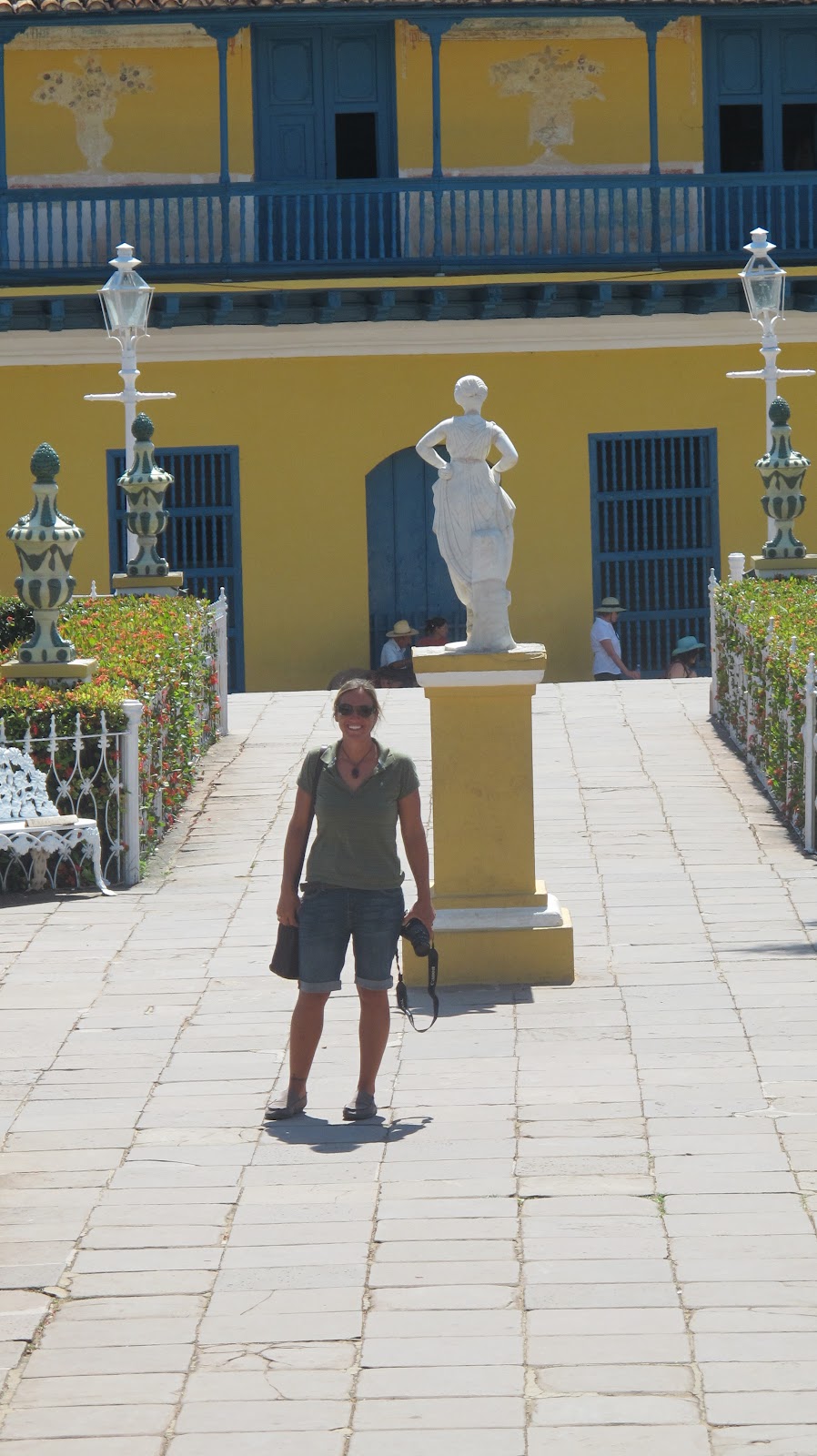
cities in the New World – it was first settled in 1514.  The city is a big tourist destination, so the streets are incredibly clean and the buildings all brightly painted.  We got dropped off in a beautiful plaza and just wandered around the small town.  Everywhere we went, there were locals selling all kinds of souvenirs.  We bargained with a lot of them as it is a great place to get stuff for family back home.  If you bring some used clothes that are in good condition or personal items like tooth brushes, tooth paste, razors, etc., you can trade with them as well.

After getting goodies for everyone, we set out to find a good lunch spot.  We found a nice restaurant with tables set up under a gigantic tree which provided ample shade from the hot afternoon sun.  We had cold beers and a good meal, which was made even better by a band of elder Cuban men belting out their traditional music.
 
We strolled around the streets for the rest of the afternoon and then caught a bus back to the boat.  Trinidad is a beautiful city that is not to be missed!

The Rest of the Cays in Jardines de la Reina (Cayo Guincho, Cayo Algodon Grande, Cayos Cuervo, Cayo Zaza de Fuera)

Cooking dinner on the fire

Over the next few days, we Cay hopped, as most were only a 15 – 25 mile sail.  We would leave in the morning to catch the breeze before it died and would try to anchor between noon and 2:00.  We would then jump in the skiff to check out the coral and hunt for dinner. 

We had read in another blog that Cayo Guincho had many lobster and the people had cooked their catch in a bonfire on the beach.  Well, I had pictures of a beautiful white sand beach, beautiful turquoise water with lobsters crawling all over the place.  This was not the case.  As with most of the cays in this area, the cays themselves are mostly mangroves and the water a little on the murky side.  They are still beautiful islands – just in their own right.  

I was a little skeptical as we started our hunt.  Instead of one long coral reef there was just a few rocks and small coral heads scattered around sea fans and grass.  But, all is not as it appeared, as we looked closer under these rocks and found 6 small lobster and one giant one!  Oh yes, I forgot to mention the two big hog fish we speared as well – more than enough food to feed the six of us.  We decided that we would also have a bonfire on the small sandy area on the island, and sent Josh and Connor in first to start the fire to smoke out the no-see-ums that are on all the islands.  Dressed in long pants and a long sleeve shirt and armed with plenty of rum to keep the bugs away, or at least help numb the bites, we made our way to the site of the great feast.  What an awesome dinner it turned out to be!   Dena had made a huge bowl of potato salad, I had made a cucumber salad and we had also brought gobs of butter and garlic to melt on the fire.  We put the lobster tails in tinfoil, did the same with the fish and put them on the hot coals.  To say the lobster melt in your mouth doesn’t do it justice!  


Great trade!
The next day, we sailed to Cayo Algodon Grande.  The anchorage is easy to enter, we never saw less than 10 feet of water entering into the protected lagoon that you anchor in.  We chose to anchor basically at the mouth of the entrance to take advantage of the breeze blowing in, which kept the bugs at bay.  There were two fishing boats also anchored in there and shortly after we arrived, they rowed over to ask if we wanted some lobster.  We said sure, and brought out a small (mickey size) bottle of rum.  They in return handed us a bucket of lobster tails…FIVE huge lobster tails!  What a trade! 

The following day, we dignied around to the north side of the island and discovered a beautiful series of beaches, all half-moon shaped with the white sand and water that went from turquoise blue to emerald green  that I had been hoping for.  We let Niko romp on the beach for a while and she discovered that the islands were in fact, not uninhabited.  Away from the perfect beach, the mangroves were the homes to many, many iguanas and juantas which look like muskrats!  Niko rushed in after them, barking and yipping, and luckily, not catching them.  We went back to the boat to get the rest of the gang and our supplies (i.e. snacks, beverages and our trusty water floaties).  We dignied to a different place and had a great beach day!
We got up  early the next morning and sailed over to Cayo Cuervo.  The weather has been fairly settled, so we anchored in front of a reef and a little farther away from land so the bugs would stay away.  We jumped in the skiff and checked out the reef on the northwest side of the island.  The water was pretty clear and the coral much prettier than the other Cays.  We didn’t spear any lobster or fish, but we have so much in the freezer, we really weren’t looking very hard for it!

The next morning we got another early start and sailed to Cayo Zaza de Fuera.  This is another mangrove Cay and we really only stopped here to rest for the night before heading to Casdila in the morning.

Niko is excited for beach day!

The only other boats we saw were local fishing boats


Beach day!!

Joana and Sabbaticus at anchor

Cayo Blanco


Old cargo ship on the beach

We left Cabo Cruz at 6am thinking that we were going to sail 55 miles to Cayo Guincho.  We had 20-25 knots of wind right on our beam and had an awesome sail.  We were cruising at 7-7.5 knots with all sails up (remember, we are 37 tons so for us that is moving!).  There was a bit of wind chop, but as we got closer to some of the reefs, the seas dropped down to between 1-2 feet!  It was ideal conditions!


Local fishermen coming to say hello
As we were about to come up to one of the passes through some cays / reefs that was about 15 miles from our final destination, our friends on Sabbaticus called us up on the VHF and said they found Cayo Blanco - a great little cay with a white sand beach and wanted to stop and do a little snorkeling and break up the trip.  We thought it was a great idea, especially Niko who was dying to run around on a beach again.  Our electronic chart said there was only 4.5 feet in there but Kevin on Sabbaticus said he didn’t see anything less than 15 so we decided to go for it.  We anchored in the nook of the Cay in about 12 feet of water.  We cleaned up the boat from our sail, put the dingy in the water and took Niko to shore to romp around.  Then we got our snorkeling gear and spear together to hunt some lobster and fish.  The water was a little murky, most likely because there were a ton of mangroves on the cay.  There wasn’t really a reef line or big coral heads, but rather almost like little boulders with fans, sea grass and a bunch of smaller fish.  The snorkeling was not quite as pretty as Cabo Cruz nor did we find any lobster, but it is a nice place to stop non-the-less, if nothing else to break up one long trip into two shorter ones.